
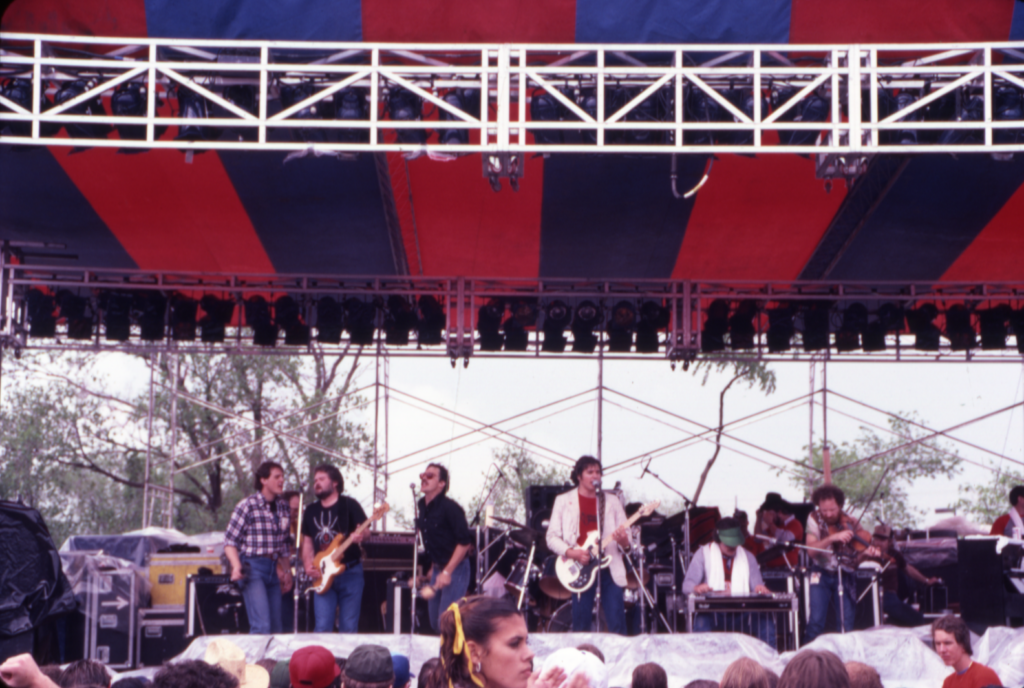
Reflections by: Bruce Jaggers, Steve Moss and Roy Pierce
Interviews conducted by: Charles “Chuck” Luck and Abi Avitia
Compiled by: Stacy Keith
Long before Joe Ely became a name known far beyond Texas, he helped shape the sound and spirit of Lubbock’s live music scene. In the 1970s and early 1980s, Ely was not simply a performer passing through town — he was a presence in the clubs, on local stages, and in the lives of the people building venues and booking music during one of the most exciting eras in West Texas entertainment. Through the memories of Bruce Jaggers, Steve Moss, and Roy Pierce, a vivid picture emerges of a musician whose energy, talent, and charisma helped define a generation of Lubbock nightlife.
What stands out most in these recollections is not just that Joe Ely played often, but that he belonged to the scene in a way few artists ever do. He was part of the same musical ecosystem as other Lubbock legends with the iconic Stubbs Bar B Que as an important musical and cultural anchor. Whether it was Main Street Saloon, Stubb’s, Fat Dawgs, Coldwater Country, or the Tornado Jam, Ely brought something electric to every stage.
**The following reflections are through the eyes of venue managers and promoters who worked directly with Ely and these memories are theirs of that very special time.
Main Street Saloon and the early days
 Bruce Jaggers came to Lubbock with a friend, and together they opened Main Street Saloon after scraping together the money to make it happen. At the time, Jaggers had never even been to Lubbock. But the idea was simple: create a place where music could live.
Main Street was a small pub, and in those early days it had a shoestring feel. The first act was Jay Boy Adams, and Ely was already part of the scene, sitting in with him. That early connection mattered. When Texas Tech and the University of Texas were both highly ranked and playing in Lubbock around 1974, Jay Boy couldn’t make the show, but Joe said he could put together a band. Texas Tech won the game, and Joe Ely’s impromptu performance that night took on a life of its own. Things went, in Jaggers’ words, “off the wall.”
That moment feels like a turning point. He was becoming the kind of performer people came to see because they knew something real would happen. He began playing regularly, and before long he was a draw in his own right. Jaggers says it was evident early on that Ely was for real.
That sense of authenticity was matched by the strength of the Lubbock music community itself. Jaggers remembers a serious scene in the 1970s, filled with extraordinary talent. Ely played with people like Lloyd Maines and Jesse “Guitar” Taylor, and his sound was rooted in the toughness and the warmth of West Texas. His work would quickly reach beyond the local scene.
Stubb’s and the heartbeat of the scene
If Main Street showed how the scene could begin, Stubb’s showed how deep it could go. In the 1970s, Stubb’s Bar-B-Q became one of the heartbeat venues of Lubbock music culture. More than a restaurant, it was a gathering place where musicians, listeners, and regulars came together around barbecue, beer, and live music. Its Sunday night jam sessions were legendary. Packed with iconic performers passing through Lubbock, Stubbs was a critical piece of the musical tapestry.
For Joe Ely and many of his peers, Stubb’s was part of the early ecosystem that helped shape the West Texas sound. It was a place where a musician could be heard before becoming widely known, and where audiences were close enough to feel every note. Stevie Ray Vaughan, Jesse “Guitar” Taylor, and Ely were among the names tied to that scene, and their presence helped make Stubb’s legendary and they built friendships there which were unshakable.
What made Stubb’s matter was not just its history, but its role in community building. In a city still defining its identity as a music town, Stubb’s gave that identity a home.
Fat Dawgs and a bigger stage
As Ely’s audience grew, so did the rooms he played. Main Street eventually became too small for the acts it was attracting, and Fat Dawgs offered a larger space for bigger names and bigger crowds. Jaggers and his team purchased Fat Dawgs in 1978 and sold Main Street in 1979, shifting their focus to the new venue. Fat Dawgs was about 4,000 square feet, which gave them room to bring in more ambitious shows and more significant acts.
Joe Ely remained a constant. He was one of the mainstays of both Main Street and Fat Dawgs, and Jaggers notes that the venue was fortunate to bring in great artists from all over, including The Planets, Ultimate Force, and Koko Taylor. A Chicago promoter helped connect them with strong bookings, and Fat Dawgs became a place where major music could happen in Lubbock.
Ely, though, had a particular effect on the crowd. He had an energy that could ignite a room, and he seemed to make it his responsibility to keep that energy alive from the first song to the last. His music blended rocking country drive with strong songwriting, and his ballads showed another side of him entirely.
There is also a wonderful story Jaggers tells from around the time Ely’s reputation was beginning to spread nationally. He went to a Robin Williams show and found that Ely was playing at Fat Dawgs. He joked that he wouldn’t have been surprised if Williams had come by the club. Well, according to Steve Moss (Tornado Jam promoter), “I brought Robin Williams to see Joe Ely at Fat Dawgs. Robin joined Ely on stage doing hand signs to West Texas Waltz. We all closed Fat Dawg’s down and went to my house to continue the party. Robin, Joe, Sharon, the Ely Band along with about 30 club regulars.”
It is a perfect snapshot of the kind of unexpected, slightly surreal magic that seemed to gather around Joe Ely performances.
As Ely moved more toward Austin and gained broader recognition, he didn’t come through as often. Jaggers reflects on how fortunate they were to have so many great Lubbock musicians born in the same era, growing up together, collaborating, and sometimes sharing bands. It was also a time when musicians from across Texas passed through town, adding to a spirit of camaraderie, friendship, and mutual respect.
Tornado Jam and the scale of Joe Ely
 If Main Street, Stubb’s, and Fat Dawgs show Ely’s local rise, Tornado Jam shows how large that rise had become. Steve Moss remembers knowing Joe since middle school, when Moss was younger and Ely was already in high school. Years later, while Moss was in Los Angeles working in film, he heard that the first Tornado Jam was going to happen in 1980. He contacted Joe, who encouraged him to come back to Lubbock and help film it.
That first year was already a major event, with an estimated 7,000 to 9,000 people in attendance. Moss and a small crew filmed it with two cameras. Stevie Ray Vaughan played that first event, along with the Maines Brothers. By 1981, Moss was working with the city, and the event continued to grow. That year’s lineup included Alvin Crow, Ray Wylie Hubbard, Terry Allen, Jay Boy Adams, and Bobby Keys. Attendance climbed close to 30,000.
The stories from Tornado Jam are the kind that become part of local legend. One year brought the famous Rolls Royce rolling into the lake. Another year, a 1964 Cadillac painted pink somehow ended up in the water too. What began as an ambitious music event was quickly becoming something larger than anyone expected.
But it all came to an end in 1983, when the City Council did not approve the event again because of damage to the buffalo grass in the park. Moss remembers that as a disappointing chapter, one that changed the course of things for him and for Joe. In some ways, that decision pushed Ely toward a different path and a broader mystique.
Moss’s memories also point to the way Ely’s influence extended well beyond Lubbock. Bobby Keys introduced him to the Rolling Stones, and Ely eventually opened for them at stadium shows. Moss says there is no one who can take you on a musical journey like Joe. He calls him a great writer and a great entertainer, someone whose background was as unusual as his stage presence. Ely had once been in the circus as a young man and worked with the world’s smallest horse and camels. That kind of life gave him a ferocity on stage and a fearlessness in the choices he made.
Coldwater Country and the perfect night
Roy Pierce’s memories from Coldwater Country add another dimension to the story. He started there washing glasses, while a friend who had grown up with him was the head bartender. But within five years, Pierce was leasing and managing the venue. Coldwater was a massive country bar housed in an old bowling center, with offices off to the side, a large dance floor in the middle, and seating along the edges. Its legal capacity was 1,600, and it operated almost every night of the week.
The venue would bring in a house band, and once a month or so they would try to land a headliner. Joe Ely was one of the artists they hoped to book regularly, along with the Maines Brothers Band. Those two alone could cover the employees and business expenses with their draw. People lined up early to see them.
Pierce says Ely dressed like country, but was really rockabilly — dynamic, magnetic, and impossible to ignore. He had no idea at the time how successful Ely would become, Pierce said at the time he thought, “We’re making this guy”, but he soon realized that Joe was making them.
Coldwater Country was more than a club; it was a room built for live connection. The stage was close to the dance floor, and the audience was right there with the performers. People would write requests on napkins and hand them up to Joe. He would look them over and often play them. That kind of interaction made the shows feel personal and alive.
Pierce remembers that Joe hated to stop playing. He was the kind of performer who would keep going until the very last song, unwilling to let the night end too soon. He was also one of the few performers at Coldwater worthy of a formal introduction. Most bands simply drifted out and began playing, but Joe deserved a proper entrance.
What Pierce loved most was the consistency of who Joe was. On stage, he transformed into something bigger, a different persona with huge presence. Off stage, he remained soft-spoken, cordial, and very much the same man. That contrast is part of what made him so compelling. He could command a crowd of hundreds or thousands, yet still feel approachable, grounded, and real.
The staff at Coldwater knew that when Joe Ely showed up on a Friday night, it was going to be a party. Tips were better, the crowd was bigger, and the energy was unmatched. It made the lyrics — “the road goes on forever and the party never ends” — feel true.
A lasting Lubbock legacy
Taken together, these memories reveal more than a list of venues. They show a city, a scene, and a musician growing into one another. Joe Ely was part of the fabric of Lubbock’s live music world when it was still being formed, and he helped give that world its pulse. It wasn’t all perfect, but few things are.
At Main Street Saloon, he was part of the raw beginning. At Stubb’s, he was part of the heartbeat of the scene. At Fat Dawgs, he helped define what a larger, more ambitious Lubbock music room could be. At Tornado Jam, he built a large-scale local legend. At Coldwater Country, he was the kind of performer who could stop a room and hold it in the palm of his hand.
And through it all, he remained Joe — soft-spoken offstage, fearless onstage, and always capable of turning a night into something people would remember for the rest of their lives.
Photos:
Featured photo of the Tornado Jam courtesy of Southwest Collection/Special Collections Library, Texas Tech University, Lubbock, Texas. Wayne Hatchel #2377
Photo of Joe Ely courtesy of Southwest Collection/Special Collections Library, Texas Tech University, Lubbock, Texas. Wayne Hatchel #0611
Photo of Lloyd Maines, Jesse Guitar Taylor and Joe Ely courtesy of Southwest Collection/Special Collections Library, Texas Tech University, Lubbock, Texas. Wayne Hatchel #0599.