
Interview with Jay Boy Adams conducted by Charles “Chuck” Luck and Abi Avitia
Compiled and written by Stacy Keith

The Underground Hubs of 1970s Lubbock
While honky-tonks dominated the Hub City with house bands performing five to six nights a week, an eclectic counterculture was quietly finding its footing. Non-country musicians gravitated toward venues like Eli’s, run by Texas Tech language professor Elias “Eli” Masso, alongside spots like Gandalf’s Staff on Avenue Q (where Orlando’s restaurant is now).
Lubbock musicians such as Tom Jones (a go-to bassist) and Curtis McBride (a studio musician with Don Caldwell) were part of this alternative rock scene at the time Adams and friend Don Densmore soon formed the acoustic driven folk/rock experimental duo Tenderfoot. The two set up living quarters above Buffalo Beno’s where the water beds were displayed near 19th and University. They had to be out each day by 9:00am before the start of business.
To expand their creative footprint, Adams teamed up with the venue owners to launch a coffeehouse called Aunt Mawdy’s Fun Garden which was started downstairs in the same building.
Soon, Adams and Densmore picked up another gig at the Tower of Pizza on Main Street. This gig paid them $25/each and including 5 large pizzas, but managing both the gigs at Aunt Mawdy’s and the Tower of Pizza soon became too much and Adams reached out to Ely for a little help and offered him some time at Aunt Mawdy’s to make the evenings less chaotic and ensure both venues had music. Ely accepted and pulled in a few fellows he’d been working on some music with including Jimmie Dale Gilmore, Butch Hancock, and mandolin player Tony Pearson (Jay’s wife’s cousin), planting the seeds for what would soon become The Flatlanders.
The hustle between sets became local lore. After opening at Aunt Mawdy’s, Adams and Densmore would sprint to the Tower of Pizza on Main Street and after the final set, haul the 5 large pizzas back to the coffeehouse, feeding all the musicians and turning late-night gigs into a shared community feast. Three nights a week, they did this crazy routine, but it kept them fed and paid and created deep and lasting friendships.
Passing Gigs and Sharing Stages
Adams eventually enrolled at Texas Tech University and began performing with his cello instructor, Arthur Follows. Through this connection, Adams was invited to open for ZZ Top when they toured through Lubbock in 1972. The performance went well and Bill Ham (the manager for ZZ Top and later Adams’ manager) asked the young musician if he would double as their guitar tech and open their shows on tour. Adams accepted and was off and running with “That little ole band from Texas”, but he had a lot of gigs he was leaving behind in Lubbock to accept this new adventure, so he handed all his regular Lubbock gigs over to Ely.
When Adams returned from the road, the Main Street Saloon was under new ownership and needed a house band. Adams took the residency, along with band members Paul Culver, David Bentley, Davis McLarty, and occasionally Lloyd Maines. Ely began sitting in at every given opportunity. This allowed Ely to experiment with his music alongside the Jay Boy Adams Band.
The Lubbock music scene operated as a tight-knit collective rather than a competition. Musician rosters regularly crossed over between groups, allowing local talent to refine their craft in front of dedicated crowds who packed the clubs night after night. According to Adams, “Fanbases in Lubbock were built on a $2 cover charge, not having a record.” Fans were hooked and would continually come back. It was an amazing time to be both a fan and a musician in Lubbock during those years with all of the talent in the city.
Adams further reflected, “You don’t know how important it is to someone like me or Joe to have someone say, ‘I was 15 and would sneak in the bar to hear you play.’ The power and emotional effect that has on someone who is in their 70’s is incredible.”
The Chemistry of High Plains Freedom
Adams recalls that Ely’s songwriting gave his backing musicians immense creative license. The compositions were approachable, melodic, and rooted in folk traditions, yet possessed the raw power to explode into roaring rock and roll on a stage. Because collaborators like Lloyd Maines were master instrumentalists, Ely designed arrangements as “stretch out” songs that allowed players to explore new territory every night.
“How are you going to hold Lloyd Maines back?” Adams asked.
That freedom of rock and roll is all about allowing those musicians to stretch. The musicians of the High Plains are not held to the same thing every night, it’s always different. That’s what allows for creativity and that’s what keeps a live performance fresh.
Ely had song after song which are “stretch out” songs. Even when Ely did cover songs, whatever he did still sounded like Joe Ely.
Adams also reflected that Ely never had a song he had to explain. Ely’s storytelling remained clear and immediate without ever needing explanation. Adams, like others we’ve interviewed for this series, reflected on Ely’s incredible stage presence saying he drew natural comparisons to close friend Bruce Springsteen. His stage performances are legendary.
Remembering a Gentle Trailblazer
Beyond his dynamic performances, Adams remembers Ely as one of the kindest and most soft-spoken individuals in American roots music. For years, as Adams traveled from the Texas Hill Country to visit his wife’s gallery in Santa Fe, he would regularly call Ely when passing through Fort Sumner—the burial site of Billy the Kid—sharing a conversation with Ely in Taos or just leaving a message for his friend on his location. He gently shared that he thinks he will have to take a different route on future trips.
Adams said of Ely that he was “One of the kindest, softest-spoken individuals on the face of the earth. He was just a deep soulful, kind individual. I’m not sure he had a cross word with anybody. I don’t think there was a bad bone in his body.”
Reflecting on Ely’s memorial, which celebrated his life chronologically from the 1970s in Lubbock through the young artists he mentored in his later years, Adams emphasized the importance of preserving the full narrative. The journey from sharing pizza at Aunt Mawdy’s to touring the world remains a testament to the soulful, unpretentious spirit that defined Joe Ely from day one.
Jay Boy Adams
Adams is an acclaimed West Texas singer-songwriter, guitarist, and producer whose soulful blend of roots rock, blues, and country helped define the region’s rich musical landscape. After cutting his teeth in early 1970s Lubbock coffeehouses and touring alongside ZZ Top, Adams signed with Atlantic Records, releasing two standout late-70s albums—Jay Boy Adams and Fork in the Road—and sharing arena stages with legends like The Allman Brothers Band, Jackson Browne, and Joe Cocker. Following a successful career running a premier concert-touring logistics company, he returned to recording and performing, earning an induction into the West Texas Walk of Fame in 2014 and continuing to captivate audiences with his authentic storytelling and dynamic live shows.
This Blog’s Featured Song:
“Me and Billy the Kid “ can be viewed on YouTube
Photo Credits
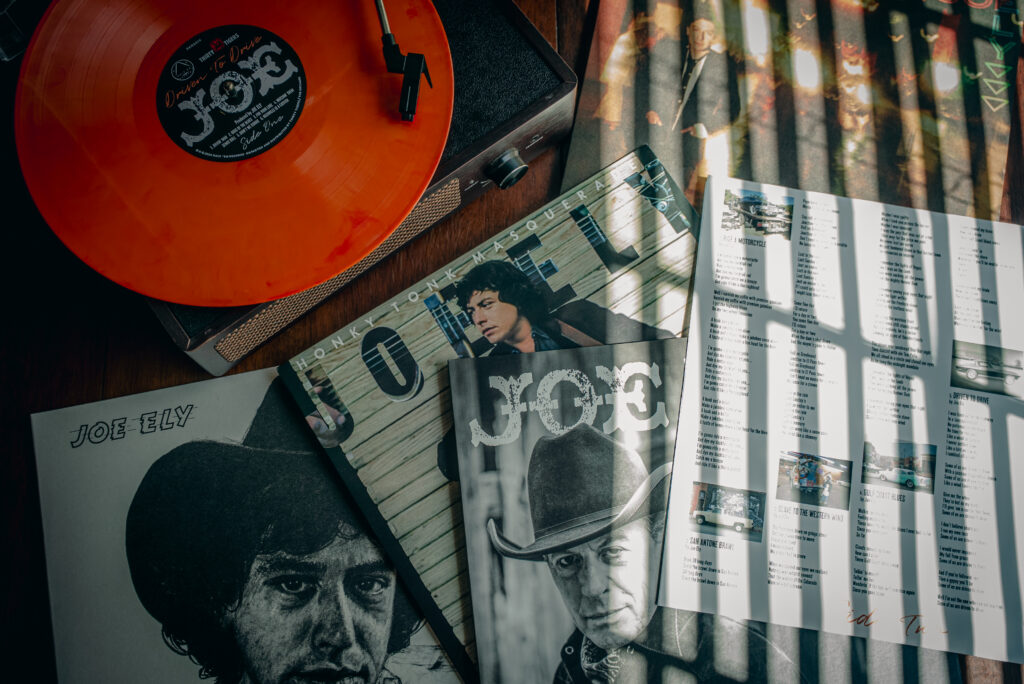
Joe Ely Albums, privately owned and photographed by EspysWorld.
Photo of Jay Boy Adams courtesy of Southwest Collection/Special Collections Library, Texas Tech University, Lubbock, Texas. Wayne Hatchel #0543