
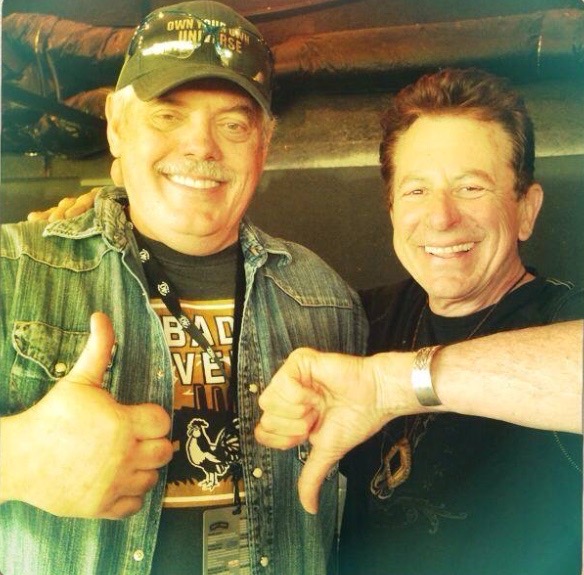
Lloyd Maines’ Reflections on his friend and bandmate.
Interview by Charles “Chuck” Luck and Abi Avitia
Compiled by Stacy Keith
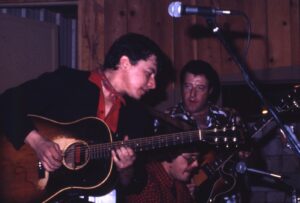

Lloyd first met Joe circa 1972 while working sessions at Don Caldwell’s recording studio in Lubbock. At the time, Lloyd was playing on a variety of projects, particularly gospel records, and was becoming acquainted with many of the musicians who would shape the city’s music scene. Through the Flatlanders, Sylvester Rice, and mutual friends, Lloyd was introduced to Joe. It didn’t take long to recognize Joe’s remarkable talent, especially on harmonica. Whenever Don Caldwell needed a harmonica player, Joe was the first person they called.
One night in 1973, Joe called Lloyd with an opportunity that would become one of Lloyd’s favorite memories. Joe was trying to raise enough money to leave Lubbock and asked Lloyd to bring his steel guitar to the Main Street Saloon near University Avenue. The plan was simple: the musicians would split whatever money they made that night. Lloyd joined Rick Hughlett on guitar and Gregg Wright on bass. There was no rehearsal. Joe called out the songs, the key, and the count-off, and the band launched into country music. “The people absolutely went nuts,” Lloyd remembered. “The crowd went crazy.” By the end of the evening, each musician walked away with $50—a considerable amount of money in the 70’s. The club owner immediately invited them back for two nights the following week.
When they returned, Lloyd couldn’t believe what he saw. “The line to get in went all the way down University and around the block.” After that weekend, Joe decided to stay in Lubbock a little longer.
Within two years, Joe had signed with MCA Records, and by 1976 his career had caught fire. The Joe Ely Band was touring coast to coast, traveling and spending much of the year on the road.
“Once people caught onto Joe,” Lloyd said, “they flocked to him.”
The band that helped launch Joe’s national career came together naturally. Rick Hulett was the original lead guitarist before eventually leaving for college. Jesse “Guitar” Taylor, who had known Joe since childhood, stepped in on lead guitar. Gregg Wright played bass, Steve Keaton handled drums, and Lloyd added steel guitar. The incomparable Ponty Bone playing accordion was added for the band’s second album and soon became a fixture.
Together, they blended country, rock, folk, and West Texas influences into a sound that felt entirely their own. Joe loved to highlight his band’s talents and offered them multiple solos during each show. “We could play on stage with anyone,” Lloyd said. “We opened for the Stones, The Clash, Linda Ronstadt and Tom Petty.”
Some artists dreaded taking the stage after Joe Ely. “No one wanted to follow Joe,” Lloyd laughed. “When he left the stage, he left nothing.”
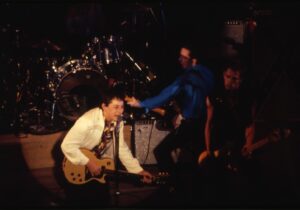
Part of what made the band special was the way the musicians complemented one another. Although steel guitar and accordion might not seem like obvious partners, Ponty Bone’s musicianship made the combination work beautifully. Joe didn’t impose rigid musical boundaries, but everyone understood the importance of leaving room for one another.
“We tried it live,” Lloyd said. “If it worked live, we stuck with it.” That philosophy also carried into the recording studio.
Chip Young produced the band’s MCA albums, with the first two records recorded in Nashville. Lloyd especially remembers recording in Young’s log cabin studio outside Murfreesboro. For a group of young West Texas musicians, it was an unforgettable experience.
Later, producer Bob Johnson, known for his work with Johnny Cash, Simon & Garfunkel, and Aretha Franklin—produced the band’s third album in Seattle. This experience was a nod to the Joe Ely Band’s talents as Johnson had worked with Bob Dylan and produced the incredibly famous “Live at Folsom Prison” album for Cash.
No matter who sat behind the recording console, however, Joe remained committed to being himself. According to Lloyd, Joe welcomed ideas in the studio but wasn’t afraid to speak up if something didn’t feel right. Creativity mattered more than perfection. Lloyd believes that sometimes musicians who aren’t polished studio veterans bring an authenticity that can’t be manufactured. Record a song too many times, he observed, and you risk losing its spirit.
That same authenticity defined Joe’s career. He never chased trends or tried to imitate someone else. He made the music he wanted to make.
Buddy Holly’s influence was always present in Joe’s musical world. While Lloyd and the Maines Brothers Band didn’t regularly perform Buddy Holly songs because they weren’t part of their style, Joe knew many of them and often incorporated Holly’s music into his performances.
(Note: Lloyd was invited by Norman Petty to Clovis to record steel guitar with Petty behind the board. Petty was a very well-known producer, having worked with Buddy Holly on some of his earliest work.)
Joe’s music eventually found an enthusiastic audience in England, where Buddy Holly remained deeply admired. British fans embraced Joe’s distinctly West Texas sound, and his popularity overseas continued to grow in some part thanks to his tours with The Clash.
Their relationship started during a record release party at Tower Records in San Francisco. While the event was underway, members of The Clash walked in. Their manager introduced them to Joe and explained that the British punk band were huge fans. They admired what Joe was doing and soon invited the Joe Ely Band to tour with them. The members of The Clash also wanted to experience Lubbock because of its connection to Buddy Holly, so they added the Hub City to their tour and played a concert at The Rox. After the concert, Joe took The Clash to Buddy Holly’s grave in the Lubbock Cemetery where they all participated in the longtime tradition of placing a guitar pick on the great man’s grave.
Touring with The Clash in 1979 left a lasting impression on Joe. Lloyd remembered Joe became even more energetic on stage after watching how seriously The Clash approached every performance. Their intensity influenced him, but Joe never stopped sounding like Joe Ely.
One of the most memorable—and infamous—shows came on October 11, 1979, at the Hollywood Palladium.
The Los Angeles punk crowd greeted the band by throwing food, cans, and bottles onto the stage. This interesting show of affection originated in England and the American audiences learned the tradition by watching televised concerts. In Europe, however, the items thrown at the bands were soft. In LA, they were lethal. The Clash had warned Joe and the band this could happen. Eventually Lloyd had enough. He asked roadie Bo Billingsley to bring out a 50-gallon barrel filled with ice and drinks that had been sitting backstage. After the final song, Lloyd and Jesse “Guitar” Taylor dumped the barrel of ice water onto the front rows of the audience.
The crowd erupted.
Ironically, the incident led to one of the band’s biggest opportunities.
Linda Ronstadt watched the entire episode from a box seat and thought it was fantastic. She later invited the Joe Ely Band to join her for twelve shows, further expanding Joe’s audience. Ronstadt would later perform at Tornado Jam in Lubbock in 1982.
“Great stories seemed to follow Joe around,” Lloyd said with a laugh.
Despite the growing success, Joe never lost sight of the people around him.
Lloyd remembers learning that the band had been scheduled for a nine-week tour. With two young children and a wife at home, he knew he couldn’t spend that much time on the road. When he told Joe, the conversation wasn’t difficult.
Joe understood. He told Lloyd to play whenever he could and assured him that he would never be replaced.
Lloyd says that kind of loyalty reflected the man Joe had always been.
The band never used a set list. Instead, everyone watched Joe. They could tell what song was coming by the guitar he picked up and the way he began strumming. It kept every performance fresh and every musician engaged. Joe also had a natural charisma that couldn’t be taught. Lloyd says he never tried to become a larger-than-life performer. He simply walked on stage and was himself. Even backstage, Joe was a true original. If the backstage area was too loud and busy, Joe would simply walk to the center of the room and stand on his head. People were so mis put by it, they didn’t know what to do, and did exactly what Joe hoped, they left.
Joe shared quiet moments with his bandmates and often exchanged guitar techniques and licks they learned from other musicians. Lloyd learned a great deal from Larry Welborn (Larry was the foundational bassist and guitarist in Buddy, Bob and Larry – Holly’s first band). Joe learned new licks from both records and other performers. Bandmate and friend Jesse “Guitar” Taylor would also share his knowledge. The friends were constantly learning from one another while remaining true to their own musical voices.
When asked what made Joe Ely such an important figure in American music, Lloyd didn’t hesitate.
“It was the fact that he was a true original artist,” he said. “He didn’t have any kind of vision of being anything other than what he was.”
That authenticity earned Joe the respect of audiences and fellow musicians alike, including Bruce Springsteen and Willie Nelson.
“They liked him because he stayed so real,” Lloyd said.
In the end, that may be Joe Ely’s greatest legacy. He never chased someone else’s sound, never tried to become what the music industry expected, and never sacrificed authenticity for popularity. His honesty, fearless performances, and unmistakable West Texas spirit created a career that inspired musicians across generations.
As Lloyd Maines reflected, “Great stories seemed to follow Joe around.”
They did—but every one of those stories began with an artist who simply refused to be anyone other than Joe Ely.
Check out “Down on the Drag” for this blog at the Joe Ely You Tube Channel HERE.
Lloyd Maines is a Grammy-winning musician, producer, and songwriter from Lubbock, Texas. Best known as a pedal steel guitarist, he has spent decades performing and producing with some of Texas music’s most respected artists, including Joe Ely, Terri Hendrix, and The Chicks. Maines has been widely recognized for his contributions to American music, including induction into the Austin City Limits Hall of Fame and the West Texas Walk of Fame.
Featured photo from the private collection of Lloyd Maines taken by Terri Hendrix.
Photos of The Clash and Joe Ely courtesy of Southwest Collection/Special Collections Library, Texas Tech University, Lubbock, Texas. Wayne Hatchel 0575
Photos of Joe Ely, Lloyd Maines and Jesse “Guitar” Taylor courtesy of Southwest Collection/Special Collections Library, Texas Tech University, Lubbock, Texas. Wayne Hatchel 0277