
Remembering his friend Joe Ely
Interview conducted by Charles “Chuck” Luck and Abi Avitia
Compiled and Written by Stacy Keith

Terry Allen is a multidimensional artist whose work encompasses cast-bronze sculpture, large-scale installations, painting, drawing, printmaking, video, and performance art. He is also celebrated as a songwriter, musician, and enduring influence on generations of artists. A true Renaissance man, Allen has consistently drawn on the people, places, humor, and hard-won mysteries of his West Texas upbringing.
He shared much in common with his late friend Joe Ely: a love of art, drawing, painting, reading, writing, and travel. Chuck Luck and Abi Avitia recently caught up with the ever-busy Allen to talk about Ely—his friend, collaborator, and one of the defining musical voices to emerge from West Texas.
Although Allen was not born in Lubbock, he moved there in time to attend Monterey High School, where future music figures including Joe Ely, Jimmie Dale Gilmore, and Butch Hancock were also part of the school’s orbit. Allen recalled that both he and Ely had already achieved a certain notoriety at Monterey.
“He did ride his motorcycle through the halls of Monterey High School, but I was the one who got thrown out for writing dirty songs,” Allen said with a laugh.
Allen first met Ely later, during the period when Allen returned to Lubbock to record Lubbock (On Everything) at Caldwell Studios. At the urging of his friend, visual artist Paul Milosevich, Allen came to town to work with Don Caldwell. Lloyd Maines—an important member of Ely’s musical circle and a key figure in the Lubbock recording community—was also working at the studio.
On the first night of Allen’s visit, Milosevich took him to Coldwater Country to hear Joe Ely perform. There, Allen saw Ely play and met him for the first time. Ely was working on studio sessions for Caldwell and was already known as a gifted harmonica player. He played harmonica on several tracks for Lubbock (On Everything), including “New Delhi Freight Train.” Allen remembered calling him the “Harmonica Wizard,” a reflection of Ely’s remarkable musicianship.
That recording period marked the beginning of a close friendship. Allen and Ely spent long hours in the studio, at Ely’s small house east of town, playing music and pool, and eating at Stubb’s Bar-B-Q. It was, Allen said, a golden era in Lubbock music—a sweet, mystical period in the early 1970s when extraordinary talent seemed to gather naturally in the Hub City. The people making music were more than collaborators; they were friends, part of a creative community.
“Joe wrote to perform,” Allen reflected. “He wrote to the song. He wrote to deliver the song.”
To Allen, Ely was a singular artist and one of the greatest live performers he had ever seen. He placed Ely alongside David Byrne, another performer Allen admired for his distinctive stage presence. Allen also remembered Ely as shy at first—until you got to know him. Then, he said, Ely was anything but shy. Allen observed that everyday life can be difficult compared with the clarity and intensity of being onstage, particularly for performers who possess Ely’s uncommon command of an audience.
An artist drawn to experiment
Ely’s restless curiosity extended beyond songwriting and performance. Allen recalled that Ely was among the first people he knew to own a computer, using it in the studio as he explored new approaches to sound and recording. Ely’s 1984 album Hi-Res departed sharply from the roadhouse country-rock sound for which he was known, incorporating electronic instruments, a Roland drum machine, an Apple II computer, and synthesizer-based experimentation. The album received mixed reviews at the time, but its adventurous approach has since become an important part of Ely’s creative legacy.
Allen also pointed to Ely’s work with German composer and conductor Eberhard Schoener, an early Moog synthesizer enthusiast. Before the Flatlanders formed, Ely participated in an experimental project with Schoener in Munich that combined acoustic guitars and synthesizer textures. Ely later credited that experience as an inspiration for his own interest in unconventional sounds and studio experimentation.
Ely was fearless about trying new things, Allen said. Within his own band, he encouraged musicians to stretch beyond familiar boundaries and develop sounds that had not been heard before. In particular, Allen recalled the inventive contributions of Lloyd Maines and Jesse “Guitar” Taylor, musicians whose work helped make Ely’s bands so distinctive.
Curiosity, motion, and the West Texas landscape
Ely’s curiosity was not limited to equipment or sound. It also drew him toward distant places and new experiences. Allen described this impulse as responding to “the necessity of your own curiosity”—a quality that continually opened new paths for Ely.
Ely toured widely, including significant associations with the Clash, and his band opened for major artists such as the Rolling Stones during the early 1980s. His friendship with the Clash helped introduce his music to audiences in the United Kingdom and beyond, an unexpected trajectory for a musician whose artistic imagination was so deeply rooted in West Texas.
“Music has always held an association with motion and cars,” Allen said. “Because there was always a song playing in the car, and there was a song playing for everything that happened in your life—a root part of yourself.”
For Allen, geography, music, travel, and wonder are inseparable. Ely’s songs often carry the language, movement, weather, and wide-open landscapes of the Llano Estacado. He was drawn to the U.S.-Mexico border as well, and that region became a recurring presence in his work.
Allen named “Because of the Wind” among his favorite Ely songs, praising the way its lyrics capture the West Texas landscape. Ely embodied a distinctive West Texas sound, Allen said, not only because he was a brilliant songwriter and performer, but because he remained open—to the road, to people, to new music, and to the force of his own curiosity.
One last song together
Allen also recalled a gathering of songwriters in Marfa. During one of those sessions, he was working on the album Just Like Moby Dick. Ely arrived a day early, before the other writers, and the two friends spent about five hours playing songs and reminiscing. The following night, Charlie Sexton joined them.
Sexton had written a chorus for
a song. Ely wrote a verse, and Allen wrote a verse. Together, they completed “All That’s Left Is Fare-Thee-Well,” which appeared on Allen’s 2020 album Just Like Moby Dick. The track is credited to Charlie Sexton, Joe Ely, and Terry Allen, and features Sexton.
It was the last song Allen and Ely wrote together.
“No more ‘one last times,’ no more second chances.
We’ve worn out all the lines, no more country dances.
No stories left to sell, no lies left to tell.
All that’s left is fare-thee-well.”
Allen is an extraordinary artist in every sense—distinctive in his visual work, music, writing, and performance. But when he spoke of Ely, his memories echoed those of many friends who shared life, music, roads, stages, and friendship with the West Texas icon.
“He had a great sense of humor, was a very kind person, a very generous soul, and a pleasure to be with,” Allen concluded.
**Check out “Because of the Wind” at YouTube.
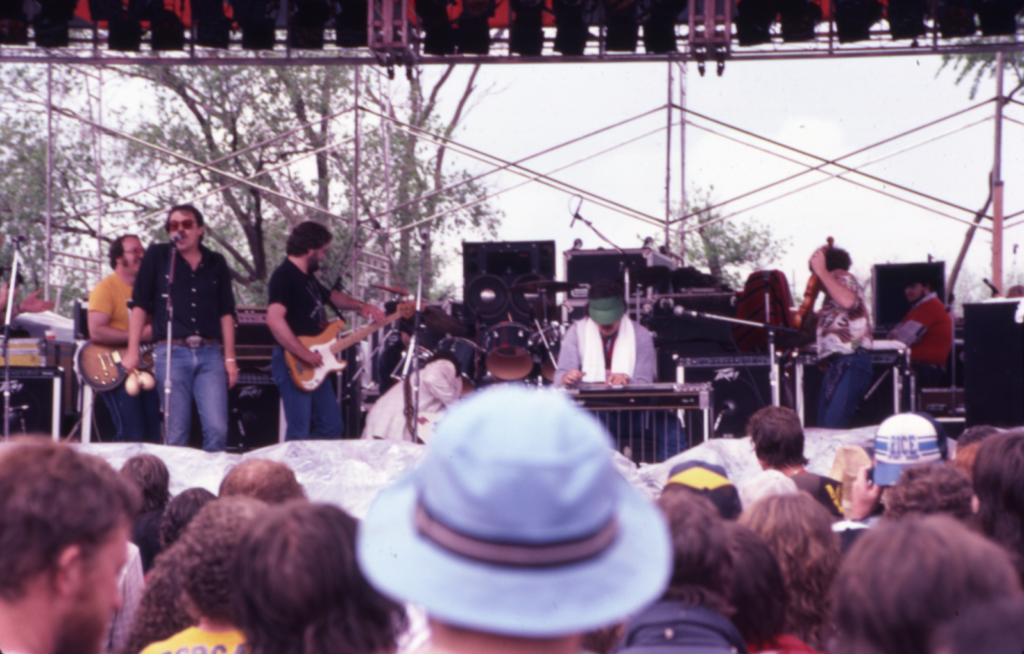
Photo of Terry Allen at the Tornado Jam courtesy of Southwest Collection/Special Collections Library, Texas Tech University, Lubbock, Texas. Wayne Hatchel #2384
Terry Allen
Allen is an American visual artist, songwriter, and musician raised in Lubbock, Texas, whose career bridges conceptual art and unconventional country music. The son of a baseball player turned entertainment promoter and a piano-playing mother, he grew up surrounded by music and performance, later graduating from the Chouinard Art Institute in Los Angeles in 1966. His drawings, sculptures, installations, videos, and theatrical works combine personal memory, dark humor, and stories of the American West, frequently crossing between visual art, performance, and song. His landmark albums Juarez (1975) and Lubbock (on everything) (1979) established his distinctive narrative approach to country music, with the latter widely recognized as an influential recording in the genre. Allen has collaborated with musicians including Guy Clark, David Byrne, and Lucinda Williams, while his visual art is represented in major collections, including New York’s Metropolitan Museum of Art and Museum of Modern Art; his honors include a Guggenheim Fellowship and National Endowment for the Arts fellowships.